PROGEN™ Advanced Cell-Free Regenerative Therapy
Cellular renewal boosters
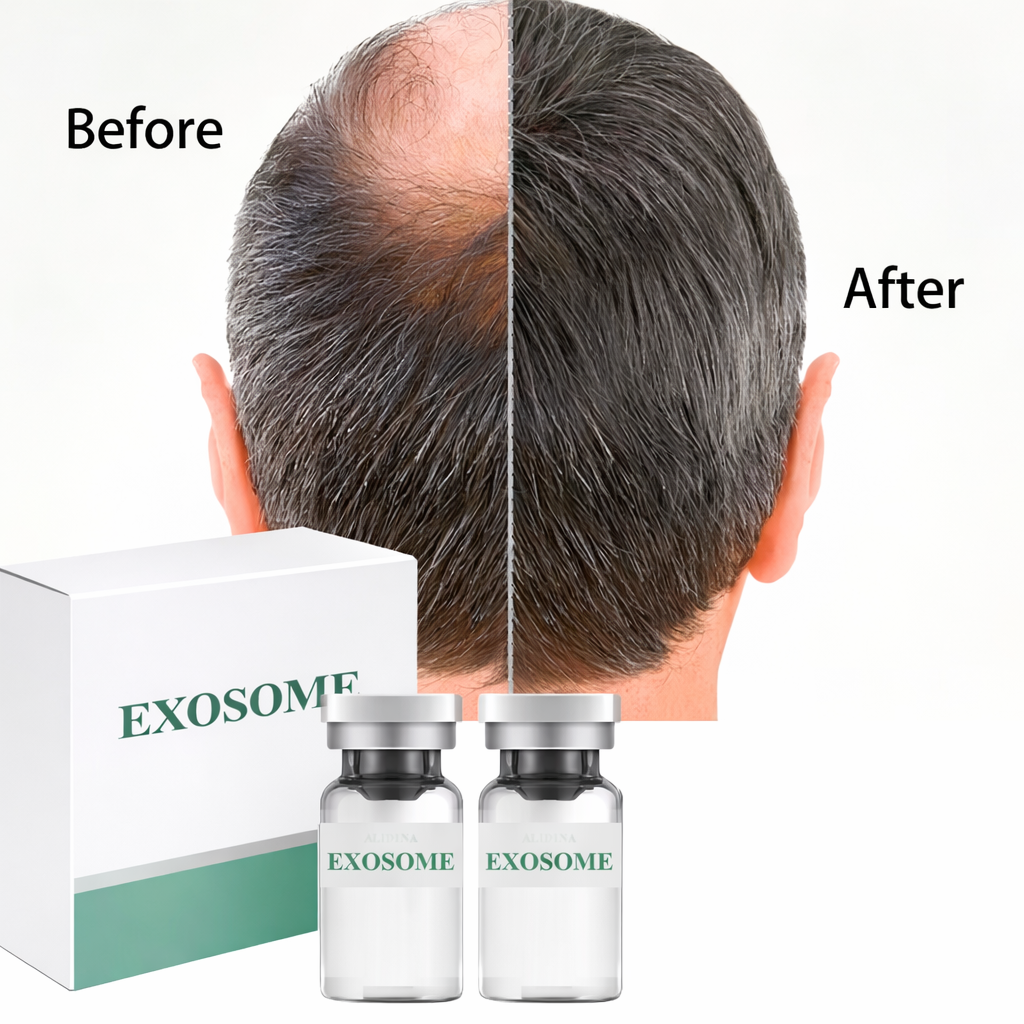
One of the most advanced cell-free hair regeneration treatments available today — using nano-sized biological messengers derived from stem cells to deliver powerful regenerative signals directly to your hair follicles, without introducing living cells into the body.
What Are Exosomes ?
Exosomes are tiny nano-sized vesicles — essentially microscopic packages — that cells use to communicate with each other. They are naturally produced by virtually every cell in the human body and travel through tissue carrying a rich cargo of molecular information: growth factors, proteins, RNA
molecules, and signaling compounds that instruct receiving cells to repair, regenerate, or change their behavior. In regenerative medicine, the exosomes of greatest interest are those derived from mesenchymal stem cells (MSCs) — powerful repair-oriented cells found in bone marrow, adipose tissue, and umbilical cord tissue.
When MSC-derived exosomes are delivered to the scalp, they carry the same regenerative signals that stem cells themselves would transmit — but without the complexity or regulatory challenges of transplanting living cells. Think of exosomes as the message, rather than the messenger. The biological instructions for regeneration are delivered precisely and efficiently, triggering a cascade of healing activity in the follicles that receive them.
What to Expect — The Procedure
No blood draw is required. Exosomes are provided as a professionally prepared, quality-controlled solution ready for administration at the time of your appointment.
Treatment Protocol
How Exosomes Work in the Scalp
When exosomes are delivered to the scalp, their bioactive cargo interacts with the cells of the hair follicle and surrounding tissue through several well-documented biological mechanisms:
01.
The WNT/beta-catenin signaling pathway is one of the most important molecular switches for hair follicle growth. It controls whether follicular stem cells remain dormant or enter the active growth phase. Published research on MSC-derived exosomes confirms that they can activate this pathway in follicular cells, promoting the transition from the resting phase (telogen) back into active growth (anagen). Studies on human umbilical cord MSC-derived exosomes have specifically demonstrated this mechanism in androgenetic alopecia models.
02.
The dermal papilla — the specialized cell cluster at the base of every follicle — is the primary target of exosome therapy for hair regeneration. Exosomes deliver growth factors and molecular signals directly to these cells, promoting their proliferation, reducing DHT-induced apoptosis, and restoring their capacity to drive the hair growth cycle. Published studies confirm that exosomes from adipose-derived stem cells (ADSCs) and mesenchymal stem cells significantly enhance dermal papilla cell activity
03.
Exosomes carry VEGF (vascular endothelial growth factor) and other pro-angiogenic signals that stimulate the formation of new blood vessels around hair follicles. This improves the perifollicular
vascular network — the blood supply system that delivers oxygen and nutrients to each follicle. Published research identifies enhanced angiogenesis as one of the key mechanisms by which exosome therapy supports hair regeneration.
04.
05.
06.
Key Benefits
What Makes Exosomes Different From PRP
Patients often ask how exosome therapy compares to PRP. Both deliver biological signals to the scalp — but through fundamentally different mechanisms: PRP concentrates growth factors from your own blood platelets. These are potent and clinically studied, but limited to the growth factors naturally present in your own platelets at the time of the draw. Exosomes, by contrast, are derived from stem cells — the most regeneratively active cells in the body. They carry a far broader and more sophisticated cargo of bioactive molecules, including microRNA, proteins, and a wider spectrum of growth factors. They can also influence gene expression within receiving cells in ways that platelet-derived growth factors alone cannot. Additionally, exosomes are nano-sized — small enough to penetrate cell membranes and interact with cellular machinery directly, rather than simply binding to surface receptors from the outside. Both treatments can be used together as part of a comprehensive PROGEN™ protocol.